
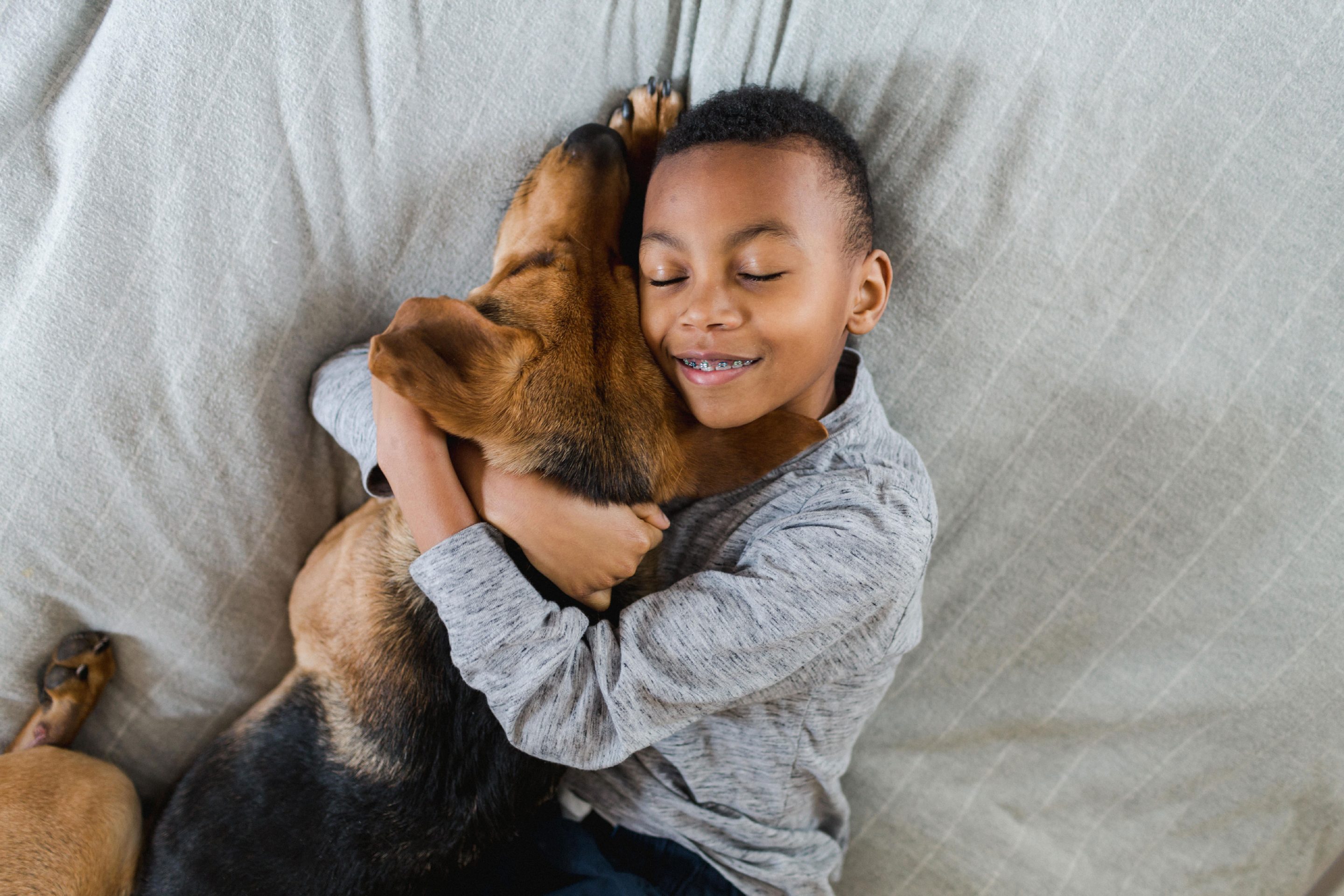
Some dogs do not need to sleep in your bed. They do not need your pillow. They do not need the warmest spot under the comforter.
They do not even need to be touching you. They just want to be close enough to know you are there. A friend of mine has a dog named Murphy, a big, gentle Lab mix with gray on his muzzle and the kind of loyal eyes that make you feel guilty for going to the mailbox without him. Murphy is not a pushy dog. He does not bark at the bedroom door. He does not scratch the paint. He does not throw himself dramatically against the wood like a dog in a tragic movie.
He simply waits.
For years, my friend had a rule: no dogs in the bedroom at night. It was not a cruel rule. Murphy had a soft bed in the hallway, another bed in the living room, and full access to the couch during the day. He had blankets, toys, water, air conditioning, and more emotional consideration than most adult humans receive.
The bedroom door closed at night.
That was the routine. Murphy seemed to accept it.
* * *
Or at least, that is what everyone thought. Then one night, my friend woke up around 2 a.m. to use the bathroom. The house was dark and quiet. The kind of quiet where every small sound feels louder than it should—the hum of the refrigerator, the click of the air conditioner, the soft shifting of the floor under bare feet.
She opened the bedroom door carefully.
And there he was.
Murphy was lying directly outside the door.
Not pacing. Not whining. Not scratching.
Just lying there, chin flat against the carpet, ears tilted toward the room as if he had been listening for any sign of life inside. When the door opened, he lifted his eyes.
That was all. He did not rush in. He did not jump up. He did not celebrate. He simply looked at her.
And that look, my friend said, broke her heart a little. Because it did not say, “I won.” It did not say, “Let me in.”
It said something softer. There you are.
I knew you were in there. For some dogs, a closed bedroom door is just a door. For others, it is a separation they accept but do not quite understand.
Dogs live in a world made of closeness. They know us by scent, sound, movement, rhythm, and routine. They know the way our feet hit the floor in the morning. They know the difference between work shoes and walking shoes. They know the sound of the garage door, the car in the driveway, the treat bag, the leash, the drawer where the medicine is kept.
At night, they know us in quieter ways.
The sound of breathing. The shift of blankets.
The small creak of the mattress when someone turns over. The familiar smell of the person behind the door. To us, a bedroom is a private space.
To a dog, it may be the place where the most important person disappears for eight hours. That does not mean every dog must be allowed in. It does not mean every closed door is unfair.
Some people have allergies. Some people are light sleepers. Some dogs pace, shed, snore, guard the bed, chew things, wake people up, or simply sleep better in another room. Some families need rules, and rules can be healthy. A dog can be deeply loved and still sleep outside the bedroom.
But if your dog lies by the door at night, try not to see only stubbornness. Try not to call it annoying too quickly. He may not be trying to break the rule.
He may be trying to stay connected to you in the only way he is allowed. Some dogs sleep beside the bed. Some sleep in a crate with the door open.
Some sleep on an old quilt near the closet.
Some choose the hallway.
Some press their head against your slippers, as if your shoes hold enough of you to count.
It can look silly.
A dog with three expensive beds choosing the strip of carpet outside the bedroom door. A dog with the entire house available sleeping on the bath mat because it smells like his person. A dog ignoring the orthopedic bed to curl up next to a pair of sneakers.
But dogs do not choose comfort the way humans do.
Sometimes they choose emotional geography. Where are you? Where did you go?
Where is the place closest to you that I am allowed to be? That is the place they choose.
* * *
Murphy eventually got a compromise. Not the bed.
Not the middle of the room.
Not the pillows.
My friend placed an old blanket just inside the bedroom door. At night, Murphy was allowed to come in and sleep there if he wanted. The first night, he walked in slowly, as if unsure whether the rule had truly changed. He sniffed the blanket, turned twice, then lay down with a long sigh.
He did not get on the bed.
He did not bother anyone. He just slept.
Every now and then, he opened one eye when someone moved, confirmed that his people were still there, and went back to sleep.
That was enough.
That is what we sometimes forget about dogs. They are not always asking for everything. Sometimes they are asking for a little.
A little closeness. A little certainty.
A little proof that the person they love has not disappeared behind a door. There is something deeply tender about that kind of love because it is not demanding in the way we expect. Murphy was not making noise. He was not forcing himself in. He was not punishing anyone for the rule.
He was simply waiting near the boundary.
Close enough to hear. Close enough to smell.
Close enough to feel less alone. Many dog owners know this exact scene. You wake up in the middle of the night, open the door, and find your dog curled outside.
You step out of the shower and discover your dog asleep on the bath mat. You come home from a trip and find that your dog has dragged one of your sweatshirts into his bed. You notice that when you are sad, your dog does not always climb on top of you. Sometimes he lies in the doorway, keeping quiet watch.
Dogs have many ways of saying, “I want to be near you.”
Some are loud. Some are clumsy. Some are inconvenient.
Some are so quiet you might miss them if you do not look down. A dog at the bedroom door is one of those quiet messages. He is not always asking to be the center of attention.
He is not always trying to take over the bed. He is not always being needy in the spoiled way people sometimes joke about. He may just be keeping track of his family.
That is what dogs have done for a very long time.
They notice where we are. They notice when we leave. They notice when we return.
They notice when a door separates us from them. And if they cannot follow, they wait as close as they can. There is a kind of faith in that.
A dog does not understand that you are asleep and safe behind the door. He does not understand privacy, work stress, sleep hygiene, or the human desire to have one room not covered in dog hair. He only understands that you are there, and he is here.
And maybe here is close enough. But maybe closer would be better. Living with dogs means making these small decisions all the time.
Where can they sleep? Where can they sit? What rooms are allowed? What routines make sense?
How do we balance cleanliness, boundaries, rest, safety, and love? There is no single answer for every home. A dog in a crate beside the bed may be perfect for one family.
A dog bed in the hallway may be perfect for another. A closed bedroom door may be necessary. An open door with a blanket just inside may be the compromise that lets everyone sleep.
The rule itself matters less than the feeling behind it. If the answer is no, let it be a calm no. Give the dog a good place to sleep.
Make the routine predictable.
Do not make him feel punished for wanting to be near you. If the answer is yes, make that yes work for the household.
A designated blanket. A bed on the floor.
A crate with the door open. A spot that lets the dog feel included without stealing your sleep. Dogs can learn boundaries when the boundaries are clear and kind.
They do not need chaos. They need consistency.
And sometimes, they need us to understand what their behavior means before we decide it is a problem. Murphy still sleeps on the blanket near the bedroom door.
Some nights, he barely moves.
Some nights, he dreams softly, paws twitching, chasing something in a world only dogs can visit. Some mornings, my friend wakes up and sees him there, curled on the old blanket, head turned toward the bed.
Not on the bed. Not asking for more. Just near.
She says it has changed the way the room feels. The bedroom is not less peaceful with him there.
It is more so.
Because there is something steady about a dog sleeping close by. Something old and simple. A soft body at the edge of the room. A familiar breath in the dark. A creature who has decided that the safest place in the house is wherever you are.
Home is the place where your person is.
That kind of trust should not be taken lightly. We often talk about how much dogs need us. Food, water, walks, vet care, shelter, structure.
All true.
But sometimes we forget how much they choose us.
Again and again.
They choose the spot near our chair.
The rug by the kitchen. The hallway outside the bedroom. The slippers by the bed.
The sweatshirt that smells like us. The side of the couch closest to our leg. The doorway between where they are and where we sleep.
They build their little maps of home around us. And because they do it so quietly, we may call it clingy. But maybe it is not clingy.
Maybe it is belonging.
Maybe it is the dog’s way of saying that the house is not only walls, furniture, bowls, and beds. Home is the place where your person is. So the next time you open the bedroom door at night and find your dog lying there, try not to be annoyed first.
Look at him for a second.
The head on the floor. The ears turned toward you.
The eyes lifting when the door opens. He may not be asking for the whole bed. He may not be asking to break every rule.
He may only be saying: I know you’re in there.
I just wanted to be close. And maybe, for a dog who loves you, that is the whole point. He was not waiting for the door.
He was waiting for you.
When the time comes to move a companion — across borders or across the country — Transcon Pet Movers handles the crates, paperwork, and customs so dogs, cats, birds, reptiles, and exotic pets travel safely. Learn more at transconpet.com or call (650) 656-0082.