
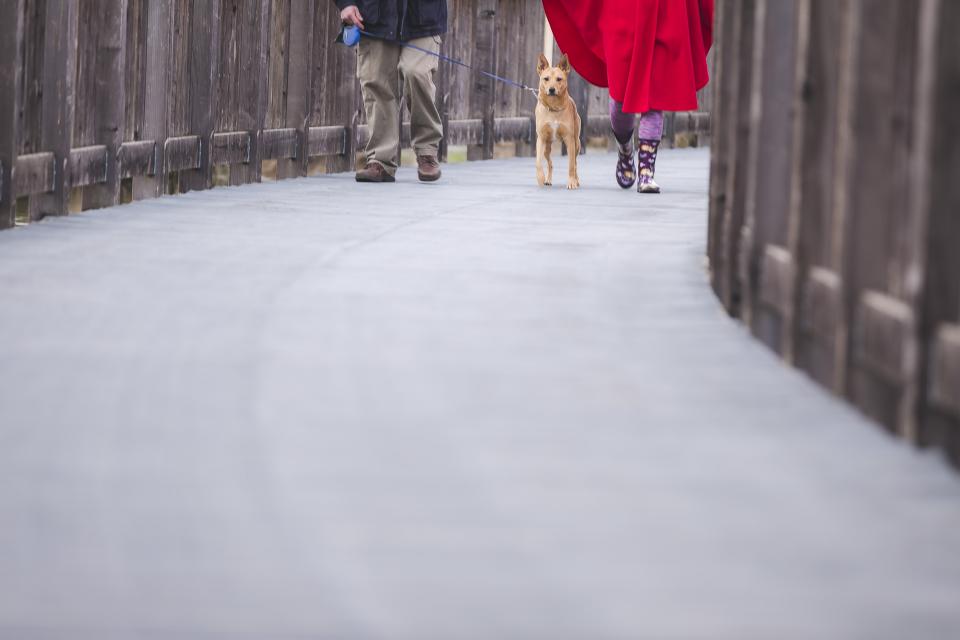
You see it all the time in apartment complexes, suburban neighborhoods, and condo communities.
The front door opens.
The dog shoots out like a rocket.
The leash snaps tight.
The owner hurries behind, half jogging, half laughing, calling, “Slow down, buddy. Slow down.” The dog is excited, of course. Outside is everything. Grass, trees, squirrels, mailboxes, old smells, new smells, the mysterious corner near the fire hydrant, the neighbor’s front yard, the sidewalk where another dog passed by sometime between midnight and breakfast.
To a dog, a walk is not just exercise.
It is the morning paper. It is social media.
It is a map, a message board, a weather report, a neighborhood investigation, and a personal adventure all at once.
So yes, dogs get excited.
But sometimes what looks like joy is also strain. A dog pulling at the end of a tight leash may look enthusiastic, energetic, full of life. And maybe he is. But his body may also be working hard in ways we do not always notice.
The neck. The shoulders. The front legs. The back. The joints.
Every step becomes a small tug-of-war.
* * *
A friend of mine has a little dog named Benny, a short-legged terrier mix with the heart of a sled dog and absolutely no understanding of his own body size. Benny lives in a condo building with an elevator, a lobby, a little patch of grass near the parking lot, and several dogs he considers either friends, rivals, or unfinished business.
Every morning, the moment the leash clipped on, Benny was ready.
Not walking ready. Launching ready.
He would pull from the apartment door to the elevator. Pull from the elevator to the lobby.
Pull through the lobby. Pull across the concrete walkway. Pull toward the grass.
His leash stayed tight from the second they left home until the second he found the first tree. My friend used to joke about it. “He just has a lot of energy.”
“He’s excited.” “He loves his walks.”
And all of that was true.
But then Benny got older. Not old. Just older.
He started hesitating before jumping off the couch. He became slower after long walks. Some mornings, after a weekend with extra outings, he looked stiff. He still wanted to go outside, but his body did not bounce back the way it once did.
At the vet, the conversation became more serious. Benny was not broken. He was not in crisis. But his body was not built for years of pulling like a tiny freight train. Short legs, extra enthusiasm, a little too much weight after a generous winter, and daily leash tension had all become part of the picture.
That was the moment my friend realized something many dog owners eventually learn. A walk can be happy and still be too hard on the dog’s body. Especially if every walk begins like a race.
This is not only a small-dog issue. Big dogs pull too. Anyone who has walked a young Lab, a shepherd mix, a husky, a pit bull mix, or an overjoyed golden retriever toward a park knows the feeling of suddenly becoming the human end of a moving anchor.
But small dogs are easy to underestimate because they do not drag us as dramatically. A ten-pound dog pulling at the end of a leash may not knock anyone over, so the behavior seems harmless. A little dachshund charging down the sidewalk looks funny. A pug straining toward another dog looks determined. A small terrier leaning into a collar looks like a wind-up toy with opinions.
But their bodies still feel the pressure.
Small necks. Short legs. Long backs. Aging joints. Extra weight. Old injuries. All of that matters.
And for senior dogs, even mild daily strain can add up. A dog does not have to cry out for something to be uncomfortable. Many dogs keep going because the walk is exciting, because they are used to it, or because dogs are often very good at hiding discomfort until the problem is no longer small.
That is why the tight leash deserves attention before the limp.
Before the reluctance to jump. Before the stiff mornings.
Before the day when the dog stops at the stairs and looks up at you as if the world has changed. Stairs are another place where this happens. People who live in second-floor apartments, townhomes, or walk-up buildings often see it every day. The door opens, and the dog bolts toward the stairs. Down he goes, fast and happy, pulling the leash, body leaning forward, front legs taking impact step after step.
When the dog is young, it looks harmless. When he is five, six, seven, or older, the habit may start to show.
He slows down. He hesitates. He skips a step. He lands differently.
He no longer wants to jump into the car. He becomes sore after busy days. Then the owner looks back and thinks, “Maybe we should have slowed this down earlier.”
That regret is common. But it is also useful.
* * *
Because a walk does not have to be a tug-of-war. And stairs do not have to be a race. Walking a dog on a loose leash is not about taking away the dog’s joy. It is not about making every walk strict, military, or boring. A dog should be allowed to sniff. He should be allowed to explore. He should be allowed to pause at the bush that apparently contains urgent information.
But he should not have to move through the world with constant pressure on his neck or body. A good walk has breathing room.
The leash can be loose. The pace can change.
The dog can sniff, stop, walk, look, and move again. The human can guide without dragging. The dog can explore without choking himself.
That kind of walk feels different.
Quieter. More connected.
Less like two creatures fighting over direction and more like two creatures sharing the same route. At first, dogs who are used to pulling may not understand. They have learned that pulling works.
Pull toward the grass, get to the grass. Pull toward the dog, get closer to the dog. Pull toward the tree, reach the tree.
Pull through the lobby, arrive outside faster. From the dog’s perspective, this is perfectly logical. So if we want a different walk, we have to teach a different pattern.
Not by yanking.
Not by yelling “heel” every three seconds. Not by turning every walk into a punishment. But by making loose leash movement rewarding.
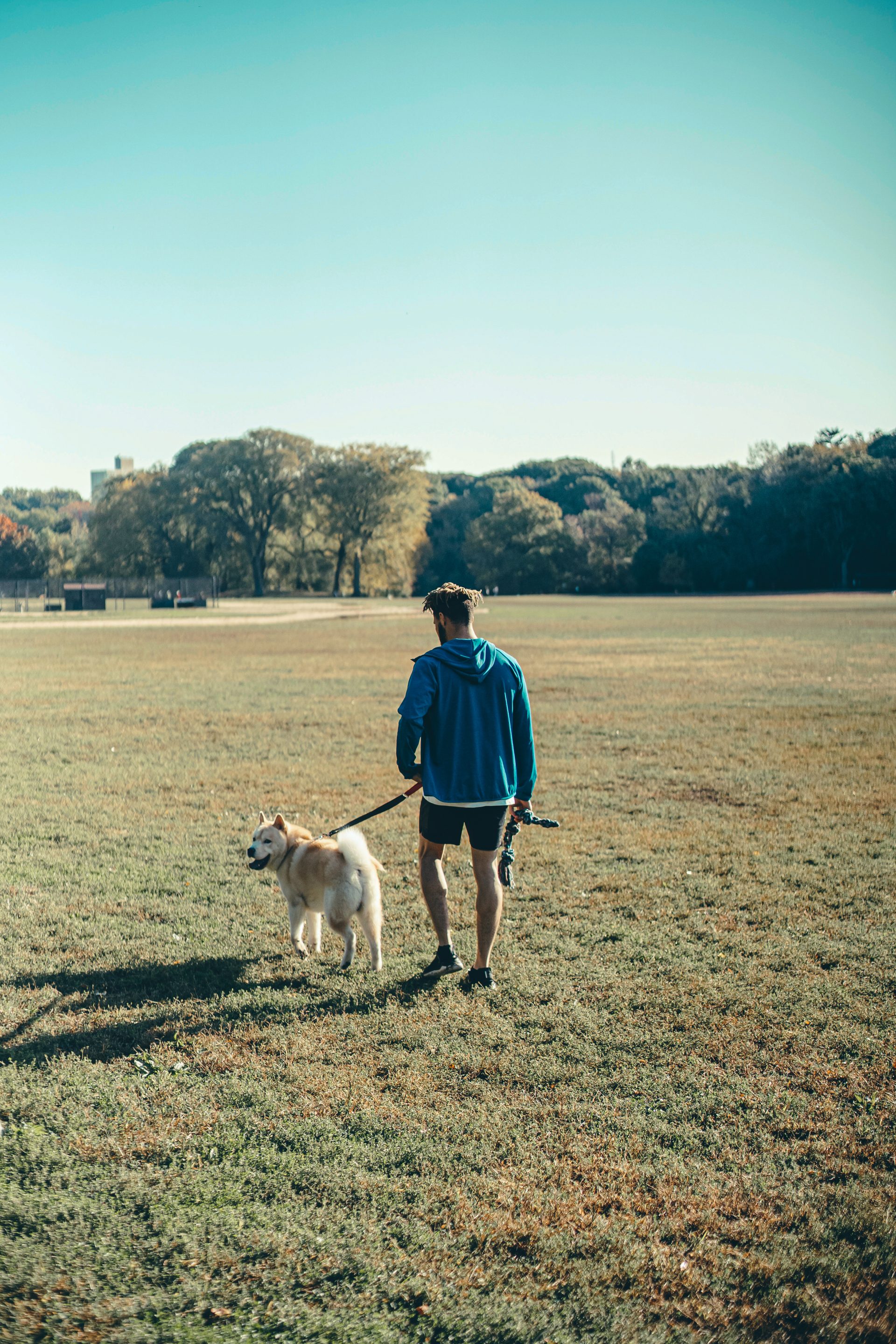
Start before the dog explodes out the door.
That part matters.
Many walks are lost before they begin. The leash comes out, the dog gets frantic, the door opens, and the first step outside already has too much speed. By then, the dog’s brain is halfway down the sidewalk.
So slow the beginning. Clip the leash calmly. Wait at the door.
Open it only when the dog can pause.
Step out together. If he rushes, stop. Not angrily. Just stop.
Let the leash tension stop moving him forward. When he turns back, softens, or steps toward you, praise him and continue. At first, this may make the walk feel very slow.
That is okay. Slow is not failure. Slow is teaching.
A walk does not have to be a battle to be happy.
For dogs who pull hard, equipment matters too. Many dogs do better in a well-fitted harness rather than a collar, especially dogs with sensitive necks, small breeds, short-nosed breeds, or dogs who already cough, gag, or strain. Some harnesses are designed to reduce pulling more safely by changing where the leash attaches.
But no equipment is magic.
A harness can help protect the neck and give better control, but the dog still needs to learn how to move with you. The human needs to learn too. Because leash pulling is not only a dog habit.
It is a team habit. The dog pulls. The human follows. The dog learns pulling works.
The human gets used to being pulled. The walk becomes a pattern both sides accept, even if neither side enjoys it very much.
Changing that pattern takes patience.
It also takes letting go of the idea that a walk must cover a certain distance. Some of the best dog walks are not long.
They are rich.
Ten slow minutes with sniffing, calm movement, and a loose leash may do more for a dog than thirty frantic minutes of dragging and tension. Dogs need exercise, but they also need information. Sniffing is not wasted time. It is part of how they process the world. A dog who gets to sniff may come home more satisfied than a dog who was marched around the block with no chance to investigate anything.
That does not mean the dog controls everything.
There are still rules.
Do not eat random things off the ground. Do not pull into the street.
Do not rush other dogs.
Do not drag the human toward every squirrel, leaf, and suspicious paper cup. But within safe boundaries, let the walk be a walk for the dog, not only a step count for the person. This is especially important in American neighborhoods where tempting things are everywhere.
Dropped chicken bones near an apartment dumpster. Fast food wrappers by the curb. Half a muffin under a café table.
Mulch. Acorns. Mushrooms. Gum.
Mystery objects no one wants to identify. A dog pulling hard is harder to guide away from those things. When the leash is tight and the dog is already lunging forward, the human often reacts late. A calmer, looser walk gives you more time to notice what your dog is about to grab.
If your dog does eat something questionable, do not panic and try random home remedies. Do not make the dog vomit unless a veterinarian or poison control professional specifically tells you to. Some substances are more dangerous coming back up, and some situations need immediate medical guidance.
Call your vet, an emergency clinic, or a pet poison hotline if you are worried. Safety is part of leash walking too.
Not just protecting the neck.
Protecting the whole dog from the world he is so excited to explore. My friend changed Benny’s routine slowly. No more blasting out of the condo door.
No racing down the hallway.
No flying down the stairs when they took them.
At the lobby, they paused.
At the sidewalk, they paused again. Benny learned that pulling did not open the world faster. Looking back did. A loose leash did. A calmer body did.
It was not perfect.
Benny still had strong opinions about squirrels. He still believed every patch of grass might contain breaking news. He still had days when enthusiasm briefly defeated training.
But the walks changed.
The leash was not tight the whole time.
The pace became more reasonable. Benny sniffed more. My friend noticed more.
The walk stopped feeling like being dragged by a very determined loaf of fur. And Benny, over time, seemed more comfortable. That is the quiet reward of better walking.
Not perfection. Comfort.
A dog moving with less strain.
A person feeling less frustration.
A leash that becomes a line of communication instead of a rope in a contest. That is what we should want for our dogs.
Not a joyless walk. Not a rigid walk. A better one.
Because a dog pulling at the end of a leash may look like he is getting exactly what he wants, but sometimes he is paying for it with his body.
His excitement is real. So is the pressure. Both can be true.
The job of the person holding the leash is to care about both. So tonight, before you rush out the door, pause. Let the dog settle for one second.
Step outside together.
If he pulls, do not immediately yell.
Do not simply get dragged. Stop. Breathe.
Invite him back into the walk.
Let him sniff. Let him move. Let the leash loosen.
A walk does not have to be a battle to be happy. Your dog does not need every step to feel like he is hauling you down the street.
He needs the world. He needs smells. He needs movement. He needs you paying attention.
And maybe, more than anything, he needs to learn that the best walks are not the ones where he pulls hardest. They are the ones where you go together.
When the time comes to move a companion — across borders or across the country — Transcon Pet Movers handles the crates, paperwork, and customs so dogs, cats, birds, reptiles, and exotic pets travel safely. Learn more at transconpet.com or call (650) 656-0082.