
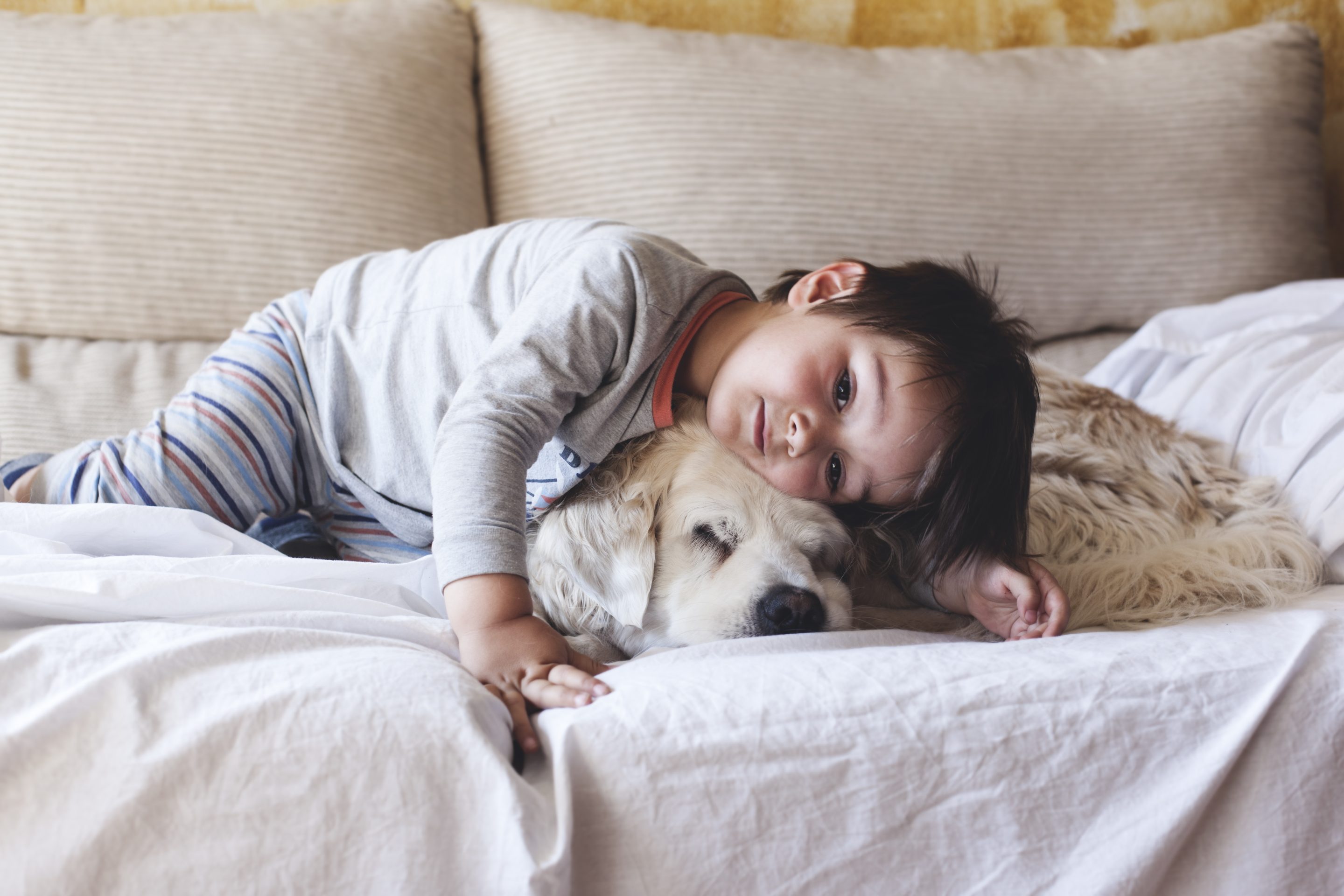
You come home late.
The house is dark except for the porch light behind you and the small glow from the microwave clock in the kitchen. You set your keys down as quietly as you can. Your shoes make the softest sound on the floor. Outside, the neighborhood is asleep—parked cars in driveways, porch flags barely moving, a few upstairs windows still lit across the street.
Then you turn on the living room lamp. Your dog is still asleep in his bed.
Not half awake. Not watching the door.
Not doing the dramatic welcome-home routine with tail thumps, sleepy stretches, and a toy grabbed in a hurry.
He is deeply asleep.
Curled on his side in the old dog bed by the couch, one ear folded under him, his front paws slightly bent, his breathing slow and even.
Then one back leg kicks. Just once. Then again.
A little twitch runs through his paw.
His whiskers move.
His mouth opens slightly, closes again, and his throat makes a tiny muffled sound.
Not a bark, not exactly.
More like the smallest dream version of one. For a second, you stand still and watch.
Then the worry comes. Is he okay? Is he uncomfortable? Is he having a nightmare? Should I wake him up?
Most dog people have had that moment. You see your dog’s legs move in his sleep, and your first instinct is concern. Maybe because dogs seem so helpless when they are asleep. The animal who spends the day following you, watching windows, sniffing grass, barking at suspicious delivery trucks, and keeping track of the entire household is suddenly somewhere you cannot reach.
His eyes are closed. His body is moving.
He is making sounds you cannot translate.
So you want to help.
But most of the time, there is nothing wrong.
Dogs dream.
And when dogs fall into deeper stages of sleep, it is common to see little movements: paws twitching, ears flicking, lips moving, tails giving small taps, legs paddling softly as if the dog is running through some invisible field. It can look strange if you have never paid close attention. It can even look a little alarming.
But often, it is just sleep.
* * *
A friend of mine has an older rescue dog named Tucker, a golden retriever mix with a white face, a gentle heart, and a long history no one fully knows. Tucker sleeps more now than he used to. He has a thick orthopedic bed in the living room, another one in the bedroom, and an unofficial spot on the rug near the fireplace that no one is allowed to move because Tucker clearly considers it important property.
At night, after dinner and one last slow walk down the sidewalk, Tucker settles into his bed with a heavy sigh.
Within minutes, he is gone.
Not gone in the way puppies sleep, suddenly and everywhere. Gone in the way old dogs sleep, as if they have earned it. Sometimes, while the house is quiet, his paws begin to move.
A small kick. Then another. His front legs twitch. His nose wrinkles.
Every now and then, he lets out a soft little sound, almost like he is talking in his sleep. The first time my friend saw it, she almost called his name.
“Tucker?”
Her hand was already halfway toward him.
Then she stopped.
Because Tucker did not look distressed. His body was relaxed. His breathing stayed steady. His face, if a sleeping dog can have an expression, looked peaceful.
So she let him sleep. That became the rule.
Unless something truly seemed wrong, Tucker’s dreams belonged to Tucker. There is something tender about that. We share so much of our dogs’ lives. We decide when they eat, where they walk, which vet they see, what food goes in the bowl, when the nail trim happens, whether the bath is truly necessary, and which parts of the couch are negotiable.
We open the doors. We hold the leashes. We clip the harnesses. We drive the cars. We make the plans.
But when a dog dreams, he has a little private world. For once, he is not waiting for us.
Not reading our faces.
Not listening for the treat bag. Not checking whether we are about to leave the house.
He is somewhere else.
Maybe in the backyard, chasing the squirrel that always gets away. Maybe at the park, running after a tennis ball before age made his body slower. Maybe on a trail full of smells so interesting no human language could ever describe them.
Maybe back in puppyhood, before we knew him.
Maybe nowhere specific at all. We do not know.
That is the mystery of it. When a dog’s paws move in his sleep, we like to imagine the best things.
The beach. The grass. The ball. The open field.
The sound of the front door opening and the person he loves coming home.
Maybe that is sentimental.
Maybe dogs do not dream in little movies the way we imagine. But anyone who has watched a sleeping dog twitch and sigh understands why we want to believe they do. Dogs spend so much of their waking lives giving themselves to us.
They learn our routines. They listen for our cars. They wait by doors. They walk at our pace.
They sit when asked, stay when asked, move when asked, stop when asked. They try, in their own dog way, to fit into human life. So when they are asleep and their paws begin to run, it feels like we are seeing something that belongs only to them.
A small leftover piece of wildness. A place where the leash is off. A place where the body remembers running.
That is why, if your dog is sleeping peacefully and only twitching, kicking, or making soft dream sounds, it is usually better not to wake him suddenly. A startled dog may wake confused. Some dogs may jump, bark, snap reflexively, or become frightened before they realize where they are. This is not because they are bad dogs. It is because being startled out of sleep can be disorienting.
Think about how it feels to be shaken awake from a deep dream. For a moment, you do not know where you are.
Dogs can feel that too.
So if you are worried, pause first.
Watch. Is your dog breathing normally?
Is the body relaxed between twitches? Are the movements brief and soft? Does he settle back into stillness?
If so, he is probably just dreaming.
Let him be.
If you truly need to wake him—maybe it is time to go out, or you are concerned for another reason—use your voice first. Say his name softly from a little distance. Let him come back to the room gradually. Avoid grabbing, shaking, or putting your face close to a sleeping dog.
Gentleness matters most when a dog is not fully aware. Of course, not every movement during sleep should be ignored. If your dog has violent shaking, prolonged stiffening, loss of bladder or bowel control, repeated episodes that do not look like normal dreaming, trouble breathing, blue or pale gums, collapse, or any behavior that seems seizure-like or medically concerning, call your veterinarian or an emergency clinic.
You know your dog’s normal.
When something is truly wrong, it often feels different.
But the little dream kicks? The tiny muffled woofs?
The twitching paws and fluttering ears? Those are often just part of a sleeping dog’s secret life. And there is something beautiful about being allowed to witness it.
There is a kind of love in not interrupting.
The house at night becomes softer around a sleeping dog.
The TV is off.
The dishes are done, or ignored until morning.
The street outside is quiet.
The dog bed in the corner holds a whole world of motion that no one else can see.
A paw kicks. An ear flicks.
A tail moves once against the blanket. And you stand there, tired from your own day, feeling your heart loosen. Because awake, your dog has already done so much.
He has followed you from room to room.
He has inspected the yard.
He has announced the mail carrier.
He has hoped for snacks. He has watched your face.
He has gotten excited when you picked up the leash. He has made a big deal out of your return, even if you were only gone twenty minutes. He has lived a full dog day.
So if he wants to run a little longer in his sleep, why not let him? Let him chase whatever he is chasing. Let him find the ball he missed.
Let him sprint across the field his older legs cannot manage as easily anymore. Let him revisit the dog park, the beach, the trail, the backyard, the sunny patch on the rug.
Let him dream.
* * *
There is a kind of love in not interrupting. We often think love means doing something.
Calling the dog. Touching him. Checking on him. Fixing the moment.
But sometimes love means standing quietly in the doorway and realizing nothing needs to be fixed.
The dog is safe. The bed is warm. The house is still. The dream is his.
My friend says Tucker still kicks in his sleep most nights.
Sometimes just once or twice.
Sometimes enough that you can almost imagine him running. His old paws move against the edge of the bed, and his cloudy eyes stay closed, and for those few seconds he is not an old dog with stiff hips and a carefully managed routine. He is just a dog running somewhere good.
No one wakes him. Someone may smile.
Someone may whisper, “Get it, buddy.”
But softly.
Not loud enough to pull him back. Because he will wake soon enough.
He will stretch. He will blink.
He will look around for his people. Maybe he will need help getting up. Maybe he will want water. Maybe he will sigh, turn in a circle, and go back to sleep.
But for that little while, he gets to keep running.
That is enough.
So the next time you come home late, turn on the light, and find your dog sleeping in his bed with his paws twitching, do not rush to wake him.
Watch for a moment. Make sure he is okay. Then let him sleep.
Maybe he is dreaming of the grass. Maybe he is chasing the ball. Maybe he is hearing your car in the driveway.
Maybe he is running toward you, the way dogs always seem to do, whether they are awake or dreaming.
We may never know.
But if the dream is gentle, let it stay his. He spends his waking life coming back to you. Let him run a little farther in sleep.
When the time comes to move a companion — across borders or across the country — Transcon Pet Movers handles the crates, paperwork, and customs so dogs, cats, birds, reptiles, and exotic pets travel safely. Learn more at transconpet.com or call (650) 656-0082.