
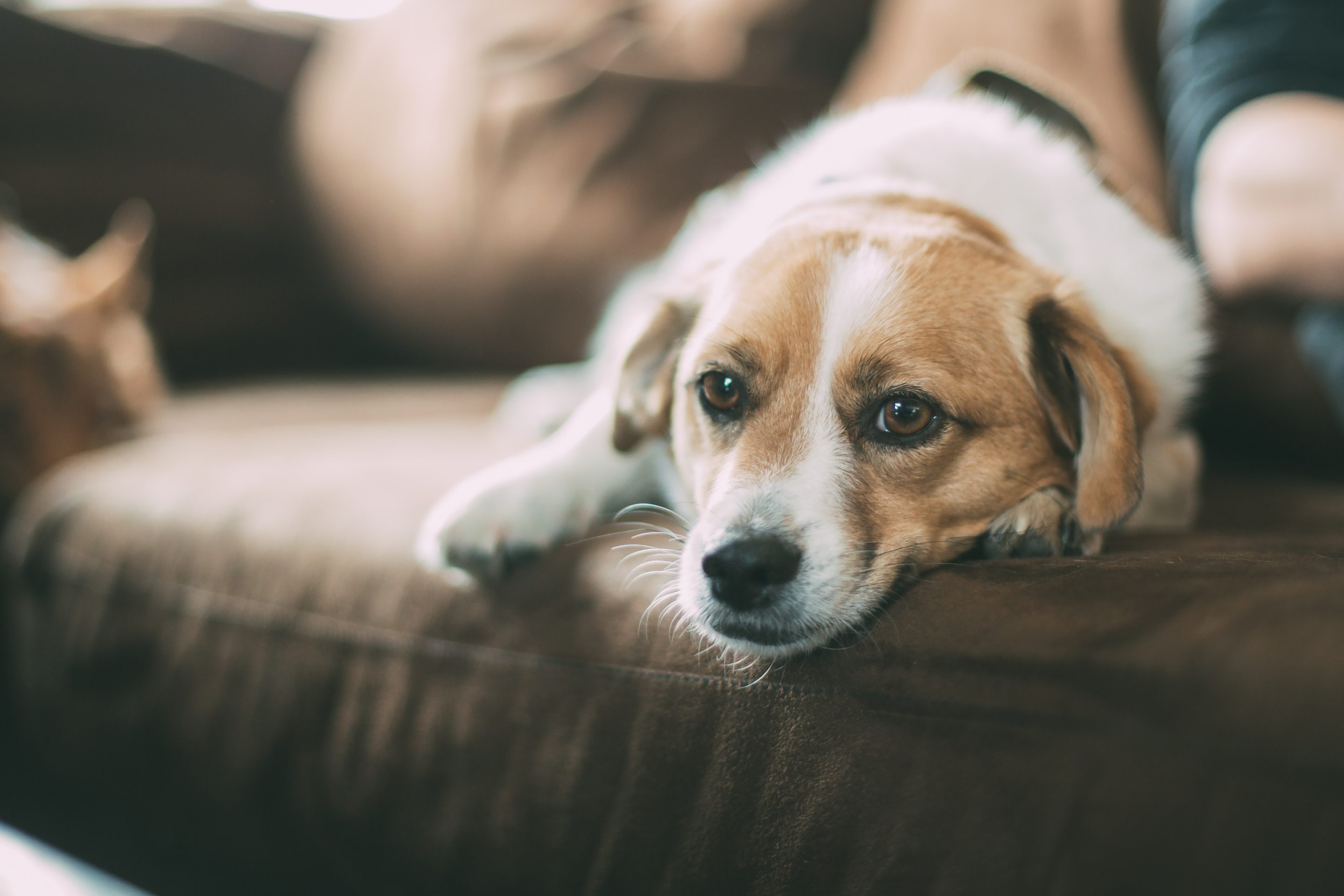
Some dogs have a place in the house that belongs to them.
Not officially. No one signed anything.
No one put up a little nameplate that says “Reserved for Bella.”
But everyone knows.
It might be the right corner of the couch. The old armchair by the window. The rug in front of the fireplace.
The sunny patch near the sliding glass door. The spot at the end of the bed where the blanket is always slightly dented and covered in fur no matter how often it gets washed. In my friend’s house, that place is the far-right corner of the sectional.
That corner belongs to Daisy.
Daisy is a medium-sized rescue dog, probably a shepherd mix with something softer in her face. She has tan fur, careful eyes, and the kind of quiet seriousness that makes people lower their voices around her without knowing why. She is not a pushy dog.
She does not bark for attention. She does not shove people off furniture. She does not leap into laps or demand that the entire household organize itself around her preferences.
Except for the couch corner. That corner is different.
If someone sits there, Daisy notices immediately. She will walk into the living room, stop beside the coffee table, and look.
Not aggressively. Not dramatically. Just look.
Her ears come forward a little. Her head tilts slightly. Her eyes move from the person to the cushion, then back to the person again.
The message is very clear. You are in my spot.
The first time I saw it, I laughed. My friend’s brother had come over to watch a game. He sat down in Daisy’s corner without knowing the household politics. Daisy walked over and stood beside him for a full minute, completely silent, staring at him with the patience of someone waiting for a clerical error to be corrected.
He looked at her. She looked at him.
Finally, he said, “Am I sitting somewhere important?” My friend laughed and said, “That’s her spot.”
He moved one cushion over.
Daisy immediately climbed up, turned in a slow circle, pressed herself against the armrest, and settled down with a long sigh.
Not a small sigh.
A deep, satisfied, slightly judgmental sigh. As if peace had finally returned to the kingdom. It is easy to call this behavior bossy.
And sometimes, yes, dogs can become too possessive over furniture. If a dog growls, snaps, guards the couch, refuses to let people move, or uses his body to control the household, that needs to be taken seriously. Furniture guarding is not cute, and safety matters.
But many dogs who love a certain spot are not trying to rule the house. They are trying to feel safe. To us, a couch corner is just furniture.
To a dog, it may be a carefully chosen location.
That corner has a backrest. One side has an armrest.
No one can sneak up from behind. The dog can see the living room. The dog can see the hallway.
The dog can see the front door. The dog can watch the family, monitor the house, and still feel protected on two sides. That matters to a lot of dogs.
Especially rescue dogs. Especially sensitive dogs.
Especially older dogs who like knowing where everyone is. Especially dogs who want closeness, but not chaos. A good spot gives a dog more than softness.
It gives orientation.
It tells the dog: here is where I am, here is where my people are, here is where sound comes from, here is where the door is, here is where I can rest without worrying that something will surprise me from behind. Dogs think about space differently than we do.
They notice entryways. Corners. Lines of sight. Escape routes. Soft surfaces. Smells. The places where people gather. The places where people leave.
The places where the sun lands in the afternoon. The places where crumbs sometimes fall. What looks random to us may be very deliberate to them.
A dog does not choose the couch corner only because it is comfortable. Though, to be fair, comfort is definitely part of it.
Dogs are experts in comfort.
They can locate the softest blanket in a house within minutes. They can turn a clean pillow into a personal property dispute. They can ignore an expensive orthopedic bed and choose a cardboard box, then later act personally betrayed if the box is removed.
But the favorite spot is often more than soft.
It smells like them. It smells like the family. It has history.
The dog has slept there through rainy afternoons, football games, movie nights, hard phone calls, Thanksgiving leftovers, quiet Sunday mornings, and evenings when everyone was too tired to do anything but sit together. Over time, that place becomes layered with belonging. Daisy’s couch corner has a permanent dent now.
No matter how much my friend fluffs the cushion, it eventually returns to Daisy’s shape. The blanket there is technically for decoration, but everyone knows it is Daisy’s blanket. It has been washed many times, yet somehow always smells faintly like dog, home, and the ordinary evenings that make up a life.
When Daisy climbs into that corner, her whole body changes. She does not have to stay alert. She does not have to follow anyone.
She does not have to decide where to be.
She has already decided.
She tucks her paws under her chest, rests her chin on the armrest, and lets her eyes drift closed. Sometimes she snores. Sometimes her legs twitch in sleep, as if she is running through a dream. Sometimes one ear flicks when the refrigerator opens, because even deep peace has limits.
When a dog sleeps like that, you know the spot means something. A dog who truly relaxes has trusted the place. That is not a small thing.
People often think dogs feel safe anywhere in their own house, but that is not always true. Some dogs are confident everywhere. Others have specific zones where they can fully let go.
The crate with the door open.
The bed under the desk. The mat near the kitchen. The chair by the window.
The couch corner with the best view of the room. These places can become emotional anchors. A dog returns to them because the world makes sense there.
That is why, when we rearrange furniture, some dogs look personally offended. They walk into the room and pause.
Where did the chair go?
Why is the couch facing the wrong way?
Who authorized this?
Dogs are creatures of pattern. They do not need everything to stay the same forever, but familiar places help them feel grounded. Their favorite spot is part of the map of home.
And home, to a dog, is not just a building. It is a collection of safe places, familiar smells, routines, sounds, and people. The front door where you come back.
The kitchen where dinner happens. The hallway where they wait. The bed where they sleep.
The couch corner where they can finally close their eyes. If your dog has a favorite spot, it may be his way of saying, “This is where I belong.” That is tender, when you think about it.
A dog comes into a human home full of rules he did not invent.
Do not chew this. Do not jump there. Do not eat that. Wait here. Sleep there. Move over. Get down. Leave it. Drop it.
Inside all those human rules, he finds one little place that feels like his.
One corner. One cushion. One blanket. One patch of sunlight.
And he returns to it again and again until the whole family understands.
This is mine. Not in a selfish way. In a home way.
Of course, humans get to sit on the couch too. A dog’s favorite place should not become a law no one is allowed to question. If a dog is guarding, stiffening, growling, or making people afraid to use furniture, that is a training and management issue. A dog should have safe spaces, but not control the household through pressure or threat.
But a quiet dog standing beside the couch and looking at you because you took the best spot? That is often not a crisis. It is a little domestic comedy.
A small reminder that the dog has preferences, routines, and an inner life that is richer than we sometimes notice. You can invite him somewhere else. You can teach a cue like “off” or “place.”
You can give him his own bed nearby. You can share the couch if that works for your home. You can keep boundaries without making fun of him for wanting the place that feels safest.
The key is to see the feeling underneath the habit.
Space made visible.
My friend does not always move for Daisy. Sometimes people sit in Daisy’s corner, and Daisy has to choose another spot. She has a dog bed near the TV, a folded quilt by the window, and at least three other acceptable sleeping options. She survives.
But most nights, when the family is just watching a show and no one needs that corner, everyone leaves it open.
Daisy climbs up. Turns twice. Sighs. Settles. The house feels complete.
That may sound silly to people who do not live with dogs, but dog people understand. Every home with a dog has little arrangements no outsider would understand. The rug that cannot be moved because the dog likes to lie there after breakfast.
The chair that belongs to the cat until 3 p.m. and the dog after dinner. The old blanket that looks terrible but cannot be thrown away because it is clearly important.
The hallway spot where the dog waits for someone to come home. The sunny square on the floor that becomes sacred every afternoon. The couch corner no one sits in unless they are prepared to be stared at.
These small things are part of the private culture of a home. They are how people and animals learn to live together. Not through grand declarations, but through repeated choices.
You sit here. I sit there. This blanket is yours. That pillow is not. You can have the corner. I get the remote.
The dog does not know the word “compromise.” But he understands the feeling of a life that has made space for him. And that is what a favorite spot really is.
Space made visible.
A place in the house where the dog’s body has been welcomed so many times that the cushion remembers him. Maybe that is why it can feel so touching to see a dog asleep in his spot.
Because he is not performing. He is not asking.
He is not trying to be cute.
He is simply at home. The paws twitching. The breath slowing.
The head resting against the armrest. The whole body saying, “I am safe enough here to sleep deeply.” For a dog, that is everything.
So the next time your dog stands beside you and stares because you accidentally took his couch corner, do not immediately call him spoiled. Maybe he is a little spoiled. Most loved dogs are, in some harmless way.
But maybe that corner is also his little den.
His watch post. His safe place.
His chosen spot in a world built mostly for humans.
Move if you want to.
Do not move if you do not. But notice what he is asking for.
Not just comfort. Belonging.
And if you do give the spot back, watch what happens. The slow climb onto the cushion.
The circle before lying down. The long sigh. The eyes closing.
The body relaxing into the shape it has made over time. That is not just a dog being dramatic about furniture. That is a dog finding his place in the home.
When the time comes to move a companion — across borders or across the country — Transcon Pet Movers handles the crates, paperwork, and customs so dogs, cats, birds, reptiles, and exotic pets travel safely. Learn more at transconpet.com or call (650) 656-0082.