
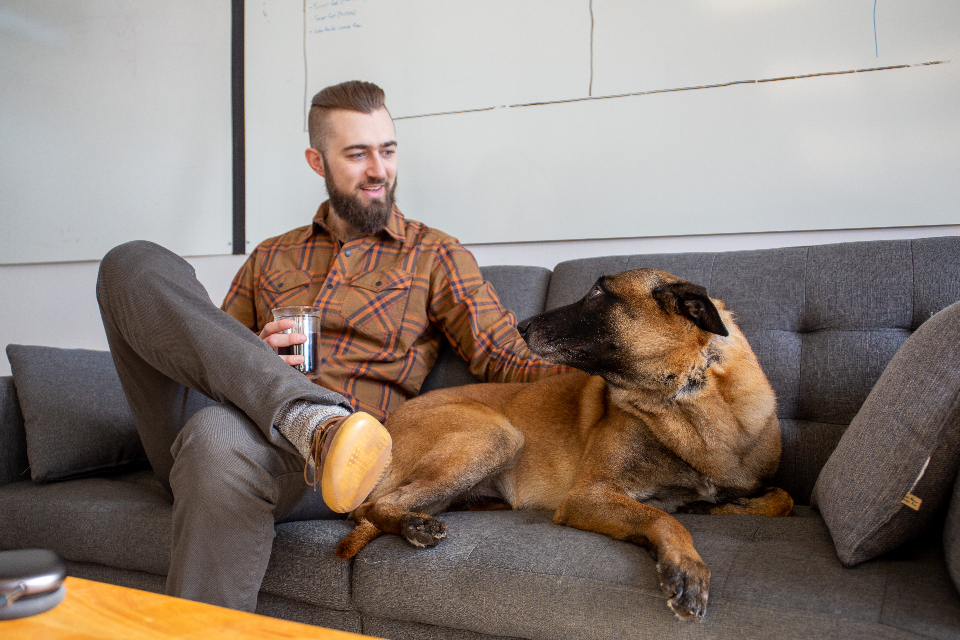
A friend of mine has a dog named Finn, a quiet shepherd mix with soft eyes, long legs, and the kind of careful manners that make people assume he wants to be touched. He does not bark when guests come in.
He does not jump.
He does not crowd the doorway. Most of the time, he lies near the edge of the living room rug or beside the couch, watching the room with polite interest. One afternoon, I stopped by my friend’s house. Finn was resting near the sofa, his front paws stretched out, head up, ears relaxed. I had met him before, and in my mind, that meant we were friendly enough.
So as I walked past, I reached down and gave him a quick pat on the top of the head.
It was automatic.
The kind of thing people do without thinking.
“Hey, buddy.”
My hand landed lightly between his ears.
Finn’s ears flattened. His neck pulled back.
His eyes blinked quickly, and his head dipped away from my hand.
It was not dramatic. He did not growl. He did not snap. He did not run. He simply shrank a little. My friend noticed immediately.
“Don’t pat his head,” she said gently. “He doesn’t like that.” I froze for a second, embarrassed.
Because in my mind, patting a dog on the head was friendly. It was affectionate. It was what people do to dogs in movies, on sidewalks, at barbecues, outside coffee shops, in front yards, at adoption events, everywhere.
You see a dog. You say hello. You reach for the head.
But to many dogs, a hand coming down from above does not feel affectionate.
It feels uncomfortable. Sometimes even threatening.
Especially when it comes from someone they do not fully trust. That is something many people forget, because humans tend to greet dogs as if dogs should automatically understand human intentions. We think, “I love dogs, so the dog will know I mean well.”
But dogs do not read our intentions first.
They read our bodies. A person standing over them.
A hand reaching toward their face.
Fingers moving over their eyes.
A palm landing on the top of the skull. To a confident, social, touch-loving dog, that may be fine. Some dogs adore head pats. Some lean into them. Some push their heads under any available hand and treat personal space as a negotiable concept.
But many dogs do not love it.
They tolerate it.
And tolerance is not the same as enjoyment.
That little flinch matters.
A dog who ducks his head is saying something. A dog who turns away is saying something. A dog who licks his lips, lowers his ears, stiffens his tail, closes his mouth, leans back, shows the whites of his eyes, or suddenly becomes still is saying something too.
He is not being dramatic. He is not being spoiled.
He is not being “too sensitive.” He is using the smallest language he has.
Please don’t.
That is the part we should respect. Dogs do not have hands to push us away. They cannot say, “I know you mean well, but I do not like being touched there.”
They cannot explain that a hand over the head makes them nervous, that a previous person was rough, that their ears are sensitive, that their neck hurts, or that they simply prefer not to be touched that way.
So they move their bodies. They duck. They shrink. They look away. They step back.
And if people ignore those quiet signals long enough, some dogs eventually have to become louder.
They growl. They bark. They snap.
Then everyone says, “It came out of nowhere.”
But often, it did not.
The dog had been speaking softly for a long time.
We just did not listen.
After that day with Finn, I started noticing how often people reach for dogs’ heads without asking.
At the dog park gate. Outside the vet clinic. At a friend’s backyard barbecue.
In the hallway of an apartment building. At a sidewalk café, where a dog is lying under the table and a stranger bends down with a hand already moving toward the dog’s face.
People mean well. Most of them do.
They love dogs. They want to be friendly. They want that sweet little moment of connection.
But loving dogs should make us more careful, not less. A dog’s body is not public property just because he is cute. A fluffy head does not automatically belong to every passing hand.
Even with our own dogs, familiarity does not mean every touch is welcome all the time. Some dogs love chest rubs but hate head pats. Some like shoulders but not paws.
Some tolerate brushing but dislike having their tail touched. Some roll onto their backs, and humans immediately assume that means, “Rub my belly,” when sometimes it means, “I am being submissive; please give me space.” Some dogs are fine with a trusted person touching their ears but uncomfortable when a guest does it.
Some dogs change as they age. A senior dog with arthritis, ear infections, dental pain, or vision loss may become more sensitive about touch than he used to be. So the question should not be, “Is this dog friendly?”
The better question is: “Is this dog comfortable?” Those are not the same.
A friendly dog can still dislike head pats. A gentle dog can still have boundaries. A well-trained dog can still say no.
And a good person should care about that no, even when it is quiet.
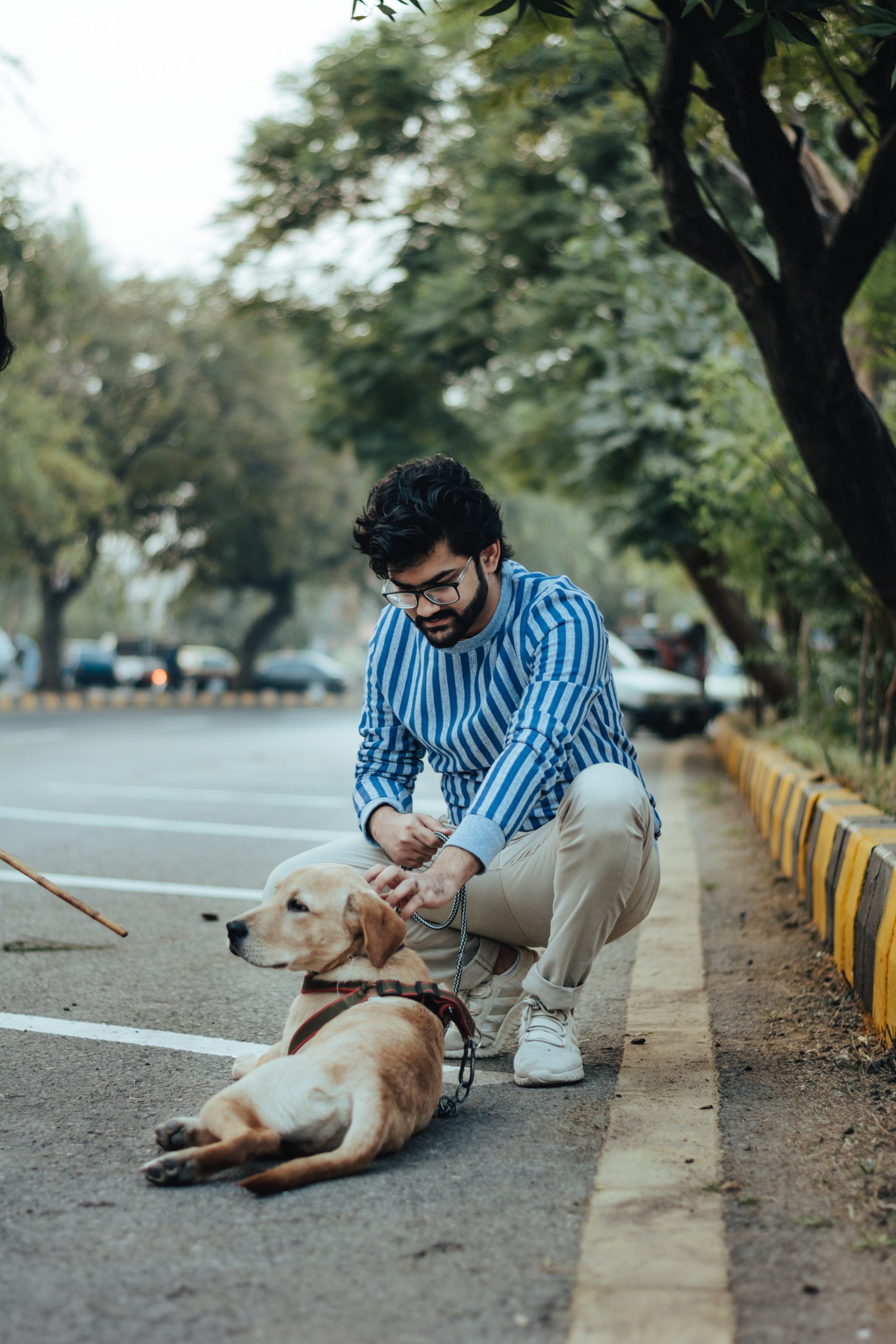
When meeting a dog, especially a dog you do not know well, it is better to slow down. Do not rush straight toward the face. Do not lean over the dog.
Do not reach down from above. Do not trap the dog in a corner, doorway, couch, crate, or under a table.
Instead, give the dog room. Turn your body slightly sideways.
Let him approach if he wants to.
Let him sniff. Keep your movements calm.
If he chooses to come closer, try touching safer, less threatening areas first: the chest, the shoulder, or under the chin if the dog is comfortable. Some dogs prefer a gentle scratch along the side of the neck rather than a pat on the top of the head. And if he moves away, let him.
Do not follow with your hand. Do not say, “Oh, come on, I’m nice.” Do not laugh and try again.
The dog already answered. Respect is not complicated.
It just requires us to notice. My friend knew Finn well enough to protect him from things he would otherwise endure politely. That is what good dog owners do.
They become translators.
They tell guests, “He likes chest scratches, not head pats.” They say, “Please let her come to you.” They say, “Don’t reach over him.”
They say, “He’s friendly, but he needs a second.” They say, “No, she doesn’t like hugs.”
The sweetest touch is the one the dog chooses to stay for.
Sometimes people take this personally. They should not.
A dog’s boundary is not an insult. If a dog does not want a stranger’s hand on his head, that does not mean the dog is bad. It does not mean the person is bad. It simply means the dog has a preference, and that preference deserves to matter.
We accept this easily with people. No one should be required to enjoy being touched on the head by someone who just walked into the house. No one should have to tolerate a stranger grabbing their face because the stranger “loves people.”
But with dogs, we often forget. We expect them to absorb our affection in whatever form we choose to offer it. Then we blame them when they tell us, as gently as possible, that it does not feel good.
Dogs are generous with us.
More generous than we deserve sometimes. They let us put on harnesses, clean ears, wipe paws, brush coats, buckle seat belts, lift them into cars, give medications, clip nails, and occasionally dress them in sweaters with names like “holiday buffalo plaid.” They tolerate a lot because they trust us.
That trust should make us more thoughtful.
Not more entitled.
The sweetest touch is the one the dog chooses to stay for. A dog leaning into your hand.
A dog softening his eyes.
A dog turning his shoulder toward you. A dog pressing his chest closer. A dog resting his chin on your knee.
A dog sighing when you scratch the right spot. A dog who could move away but does not.
That is affection. Not the touch we take. The touch he accepts freely. Finn taught me that.
After my friend corrected me, I stopped reaching for his head. I crouched lower, turned a little sideways, and let him decide. He sniffed my hand, stepped back, thought about it, then came closer and leaned his shoulder against my knee.
My friend smiled. “He likes that,” she said.
So I scratched his shoulder gently.
Finn’s ears stayed soft. His body relaxed. He stayed there.
That felt different from the head pat.
Less automatic. More like a conversation. And honestly, better.
Because this time, he was not enduring me.
He was participating.
That is the kind of relationship dogs deserve, even in small moments.
Especially in small moments.
The way we touch a dog tells him whether we are listening. If he ducks and we stop, he learns we noticed. If he turns away and we give space, he learns we respect him.
If he comes closer and we touch gently, he learns that closeness can be safe.
Those lessons matter.
They build trust quietly over time. A dog does not need to be touched everywhere to be loved. He does not need to accept every hand.
He does not need to prove he is good by tolerating discomfort. Sometimes the kindest thing we can do is let a dog have his own body. So the next time you reach for a dog’s head and he ducks, pause.
Do not laugh at him. Do not call him dramatic.
Do not tell him he is fine. He may not be afraid of you exactly.
He may not dislike you. He may simply be saying: Not there. Not like that. Please listen.
And if you do listen, something lovely may happen.
He may come back. He may offer his shoulder. He may sit beside you.
He may trust you a little more because you were one of the rare humans who heard the quiet no and honored it. That is worth more than a head pat.
When the time comes to move a companion — across borders or across the country — Transcon Pet Movers handles the crates, paperwork, and customs so dogs, cats, birds, reptiles, and exotic pets travel safely. Learn more at transconpet.com or call (650) 656-0082.